

You know that feeling. Not sadness. Not burnout. Just a kind of flatness – like someone turned the brightness down on your life, slightly and quietly, and you can’t quite remember when it happened or why.
You’re sleeping. You’re eating reasonably. Nothing catastrophic has occurred. But the motivation that used to show up reliably? Gone. The pleasures that used to land? Muted. And the feeling of being genuinely up for things has been replaced by a persistent, low-level meh.
Here’s what almost nobody tells you: that feeling has a biological address. And it doesn’t start in your brain. It starts lower down.
In this piece, we’re going to trace exactly how your gut talks to your brain – and what happens to your mood, your energy, and your mental clarity when that signal gets corrupted. By the end, you’ll understand something that most clinical approaches are still catching up with.
Part One: Recognition
Let’s start with a name.
Ben is thirty-eight years old – a software architect, the kind of person who builds the invisible infrastructure that other people’s lives run on. On paper, he’s doing fine: good job, long relationship, manageable mortgage, weekend runs.
Looking back, he’d say it was perhaps two years ago – maybe longer – that something first felt different. But that’s the thing with this kind of change: it doesn’t arrive as an event. There’s no morning you wake up and notice it. It accumulates in the background, quietly, until one day you realise it’s been there for a while. You can’t say when it started, or name exactly what it is, or what – if anything – triggered it. What you can say is that at some point the noticing began. And once it did, the awareness itself became its own weight. He started looking for the problem. He started looking for the solution. Neither revealed itself.
He sits down at his desk in the morning and the part of him that used to feel engaged – the part that would lean into a problem with something resembling pleasure – doesn’t quite show up. He finishes the day. He puts dinner on. He watches something on television he won’t remember tomorrow.
Ben has tried the obvious things. He cut down on alcohol. He started going to bed earlier. He bought a better mattress. Nothing has moved.
His doctor called it low mood. A therapist he saw briefly called it adjustment disorder. Ben calls it something simpler and harder to name – he calls it losing himself.
The part that no one has mentioned yet? Ben’s gut. Not because he has digestive problems – he doesn’t, particularly. But because the gut and the brain are in constant, continuous conversation, and that conversation shapes everything: how you experience pleasure, how quickly you recover from stress, whether the morning feels like something worth getting up for.
Most people think of the gut as a digestive organ – a tube that processes food. That’s true, but it’s roughly as complete as saying the heart is just a pump. The gut is also, and this is where the science becomes quietly remarkable, one of the primary communication systems in the body. It has its own nervous system. It is in dialogue with the immune system, the hormonal system, and the vagus nerve – the long, wandering nerve that serves as the main channel between your gut and your brain – every hour of every day.
That dialogue is not background noise. It is one of the primary inputs into how your brain determines your emotional baseline.
When the gut is healthy – diverse, well-fed, functioning well – the messages it sends upward are broadly stabilising. When the gut is inflamed, impoverished, or disrupted, the signal changes. It becomes a signal of threat, of low resources, of shutdown. Not because anything catastrophic has happened. Just because the signal has degraded.
Part Two: The Mechanism
Here’s the first thing to understand.
The vast majority of the body’s serotonin – somewhere in the region of 90 to 95 percent, according to most estimates – is found in the gut, not the brain. The brain produces its own supply separately, but it is a small fraction of the total.
This surprises people, because serotonin is the neurotransmitter most associated with mood, motivation, and emotional stability. When clinicians talk about depression, they often talk about serotonin. And yet the majority of it is being produced somewhere most people would never think to look.
There’s an important nuance worth being precise about. The serotonin produced in the gut does not cross the blood-brain barrier – it cannot move directly into the brain. So it would be an oversimplification to say that gut serotonin is the same thing as the mood-regulating serotonin in your central nervous system. They are separate pools.
But that separation doesn’t mean gut serotonin is irrelevant to how you feel. It communicates upward through the enteric nervous system and through the vagus nerve, influencing mood regulation, sleep onset, and the general architecture of how rewarded and motivated you feel during a day. And there is a secondary pathway that matters enormously: certain gut bacteria help regulate the availability of tryptophan – the amino acid that the brain uses to manufacture its own serotonin. When gut health is compromised, that pipeline is affected too.
Think of the gut not as a direct serotonin supplier to the brain, but as a critical piece of infrastructure that the brain’s own production system depends on. When that infrastructure is in poor condition, the whole system suffers.
The second mechanism is what researchers call intestinal permeability – sometimes referred to informally as leaky gut. When the gut lining is chronically inflamed, it becomes less selective, allowing compounds through that shouldn’t be there. In particular, bacterial byproducts called lipopolysaccharides. Once those compounds enter the bloodstream, they cross the blood-brain barrier and activate the brain’s resident immune cells, called microglia. When microglia activate, they produce neuroinflammation – and neuroinflammation is increasingly identified as a core biological process underlying the fatigue, cognitive slowing, and emotional flatness that people like Ben experience. The state that doesn’t quite meet the clinical threshold for depression, but that makes a life feel smaller and greyer than it should.
Research examining the gut microbiome in people with depression has consistently found meaningful differences in microbial composition compared to those without it, with certain protective bacterial populations notably reduced. People with the most diverse gut microbiomes tend to show better mood stability, lower circulating inflammatory markers, and faster recovery from psychological stress.
Burnout and gut inflammation are not two separate problems running in parallel. They are the same problem, expressed at different addresses in the same communication network. Treat one without the other, and you are solving half an equation.
Which raises a question most clinical advice never asks: if the gut is this central, why does almost no standard approach to low mood or burnout start there?
Part Three: The Reframe
The reason people stay stuck – and Ben stayed stuck for eighteen months – is structural.
The model most of us have inherited for thinking about mental health is brain-first, and often brain-only. You feel low, you seek help, and the conversation – understandably – centres on the brain: therapy, medication, mindset. All of it directed at the organ sitting above the neck.
For people who are prescribed antidepressants, this is worth understanding clearly and without alarm. Pharmacological treatment is important and appropriate, and nothing here should be read as a case against it. What the emerging research suggests, however, is that medication may work most effectively when it is supported by changes to the environment in which the gut and brain are operating.
In a typical clinical consultation, there simply isn’t enough time to go through a patient’s diet in detail, review their sleep architecture, or work through the specific habits that may be quietly prolonging the problem. Patients are frequently reminded that sleep and diet matter – that part is well established. But the conversation usually stays at the level of a general recommendation: eat better, sleep more. What tends not to happen is a granular look at the actual dietary patterns and routines that may be creating the conditions for slower recovery.
The result is that small but consequential habits persist – not through negligence, but through lack of specific guidance. Those habits continue to act on the gut environment in ways that work against the treatment being received. The underlying gut-level inflammation isn’t addressed, and the root of the problem remains intact.
Growing research supports the view that dietary interventions can serve as meaningful complementary strategies alongside conventional treatment for depression and anxiety – not as replacements, but as additions that address something conventional treatment alone typically does not reach. This is an active and developing area of research, and the evidence base, while promising, is still maturing. But the direction of travel is clear.
The gut-brain axis is well established in the research literature. What’s lagging is integration – the process by which these findings move into routine clinical conversations. That gap is not unusual, and it isn’t anyone’s fault; translation from research to practice takes time. But it means many people are addressing their mental state without ever examining the gut environment that may be continuously working against them.
The picture becomes even clearer when you consider how everything connects.
What you eat is the most direct modifiable input into the microbiome. Ultra-processed food, low dietary variety, excess refined sugar – these don’t just affect weight or energy in the obvious ways. They starve the bacterial populations that the gut, and through it the brain, depend on.
Regular physical movement has direct effects on microbiome composition – through mechanisms including reduced intestinal transit time and effects on bacterial populations – in ways researchers are still mapping but that are already measurable.
Chronic stress increases gut permeability within hours of onset. This is the biological explanation for why anxiety and digestive discomfort travel together so reliably: they are the same system responding to the same signal.
And sleep – particularly deep, restorative sleep – is the period during which gut repair and microbiome regulation occur most actively. Disrupting sleep disrupts gut health. Disrupting gut health disrupts sleep. It’s a loop. Each element depends on the others, and when one weakens, the rest compensate until the whole system tips.
Part Four: What to Actually Do
Here’s how to work with this, in two steps. Neither is dramatic. Both are grounded in the research.
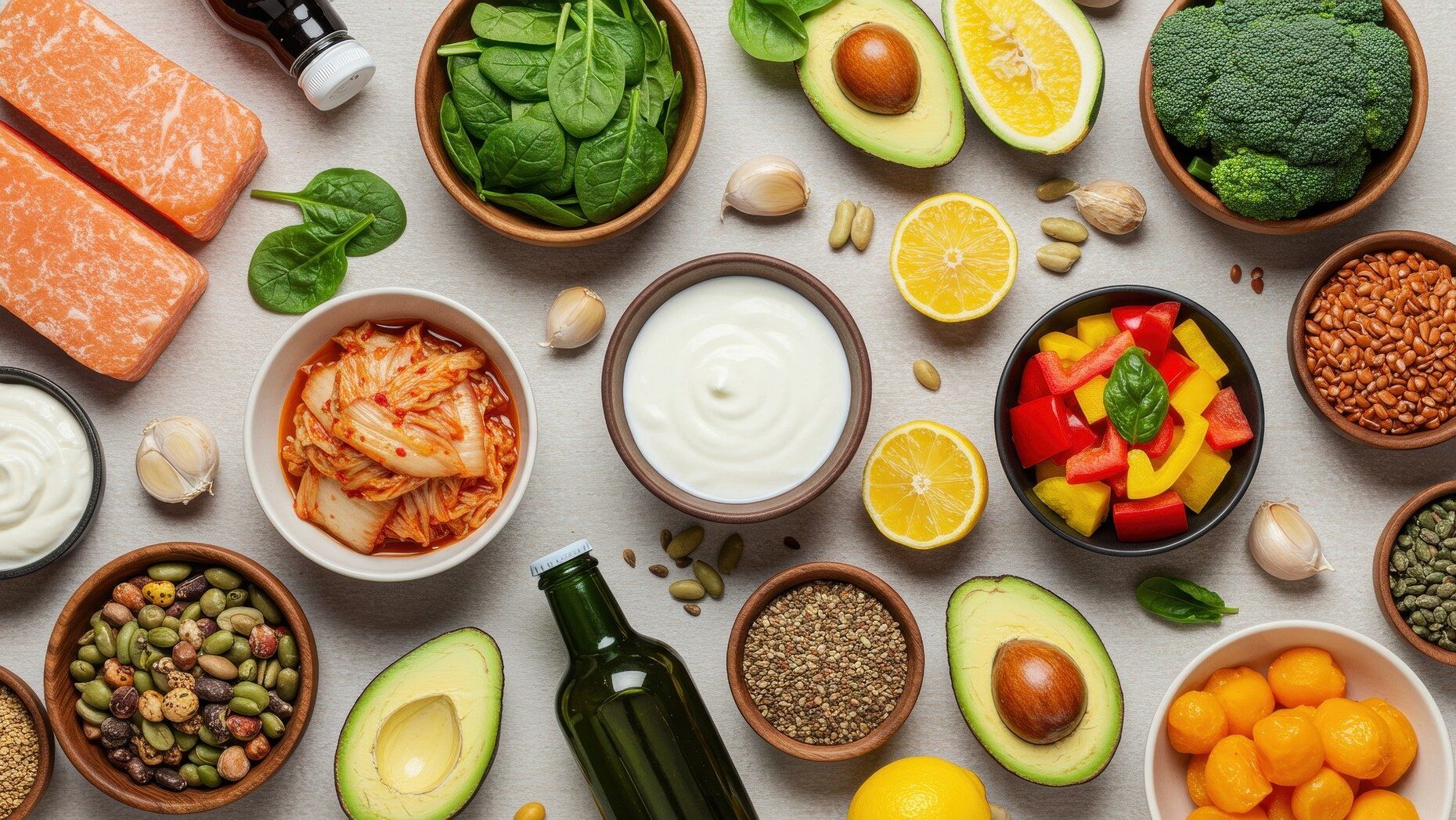
Researchers at Stanford’s School of Medicine ran a clinical trial over ten weeks. They split thirty-six healthy adults into two groups. One group significantly ramped up their fibre intake – fruits, vegetables, legumes, and whole grains. The other group added fermented foods to their daily diet: yoghurt, kefir, kimchi, sauerkraut, kombucha.
The expectation was that fibre would produce the biggest improvements. That’s what the field had largely assumed. The results told a more complicated story.
The fermented food group showed measurable increases in gut microbial diversity and reductions in nineteen inflammatory markers. The high-fibre group didn’t show significant changes in diversity over the same period – although their existing bacteria did become functionally better at processing what they were given.
The distinction matters: fibre feeds the bacteria you already have. Fermented foods introduce new ones. And if your gut diversity is already low, you need that introduction before the feeding can do its best work.
Step one – introduce. One fermented food per day, consistently, for four weeks. Yoghurt, kefir, kimchi, sauerkraut, kombucha – any one of these is enough to begin. You don’t need all of them. You need consistency. Over weeks, this diversifies your gut environment, reduces inflammatory signalling, and begins to shift the signal your gut sends upward. Changes can become visible within four to eight weeks.
Step two – sustain. Once the fermented food habit is settled, add one fibre-rich fruit or vegetable each day. Bacteria – including the new ones arriving from fermented foods – need fibre to thrive. Without it, they arrive in an environment that offers them very little to work with.
A word on what actually counts. People often assume common items – a slice of tomato, a few lettuce leaves – are meaningful sources of fibre. They aren’t, in useful quantities. The simplest options that require no cooking and deliver real amounts:
- An apple or pear with the skin on – around 4 to 5 grams, no preparation required.
- A handful of raspberries or blueberries – fibre, plus compounds that reduce gut inflammation in their own right.
- A small tin of chickpeas or lentils, rinsed – half a cup of lentils delivers around 8 grams, eaten cold, added to anything.
The point isn’t perfection. It’s building both habits – something to introduce new bacterial life, and something to feed it. Together they do more than either would alone.
Ben spent a long time trying to manage his flatness at the level of his brain – through willpower, through discipline, through showing up and hoping something would shift. What he hadn’t considered was the environment his brain was operating in. The gut responds to what you consistently give it. Give it the right inputs, and the signal it sends upward begins to change. Not overnight. Not dramatically. But measurably, and in a direction worth travelling.
If you recognise something of Ben in yourself, here’s where to start. One fermented food, every day. Then, once that’s settled, one fibre-rich addition alongside it. Four weeks. Pay attention.

In Summary
The gut is not a passive bystander in your mental life. It is an active contributor to your emotional baseline – through serotonin infrastructure, through the vagus nerve, through inflammation that reaches all the way to the brain. When gut health deteriorates, the signal degrades. And the brain responds accordingly.
Two steps. Fermented foods to introduce new microbial life. Fibre-rich foods to sustain it. That’s the biology working with you instead of against you.
Ben didn’t overhaul his diet overnight. Not every day looked the same. On the days that had cost him most, he kept to one small thing.
There was no morning he woke up and noticed it had changed. It accumulated in the background, quietly – until one day he realised that the things which used to matter had started to matter again. The flatness had lifted, not all at once, but slowly, the way it had descended. And somewhere along the way, without quite noticing when, the colour had come back.
Next time: procrastination – not the version about poor time management or lacking discipline, but the version where a specific part of your brain is treating your most important work as a threat, and responding accordingly. Once you understand the mechanism, it stops feeling like a character flaw.
This is Your Space Today – delivering the science-backed clarity you need every week because your health journey deserves expert guidance.
If you found value in this article, I’d really appreciate it if you’d share it with friends or family who might be struggling with similar issues. Sometimes, understanding that we’re not alone in this struggle, and that there are real, science-based explanations for what we’re experiencing – that knowledge alone can be incredibly empowering.
This article is for educational purposes only and does not constitute medical advice, diagnosis, or treatment. Always consult with your healthcare provider regarding any health concerns. You can find detailed information here.
Thank you so much for spending this time with me today. Until next time, take care of yourself. You deserve it.
Scientific References
If you’d like to explore the research behind this article, here are selected peer-reviewed studies supporting the key points discussed.
- Borgiani, G., Possidente, C., Fabbri, C., Oliva, V., Bloemendaal, M., Arias Vasquez, A., Dinan, T. G., Vieta, E., Menchetti, M., De Ronchi, D., Serretti, A., & Fanelli, G. (2025). The bidirectional interaction between antidepressants and the gut microbiota: are there implications for treatment response? International Clinical Psychopharmacology, 40(1), 3–26. https://www.researchgate.net/publication/378491457_The_bidirectional_interaction_between_antidepressants_and_the_gut_microbiota_are_there_implications_for_treatment_response
- Breit, S., Kupferberg, A., Rogler, G., & Hasler, G. (2018). Vagus nerve as modulator of the brain-gut axis in psychiatric and inflammatory disorders. Frontiers in Psychiatry, 9, 44. https://www.frontiersin.org/journals/psychiatry/articles/10.3389/fpsyt.2018.00044/full?s=04
- Cryan, J. F., O’Riordan, K. J., Cowan, C. S. M., et al. (2019). The microbiota-gut-brain axis. Physiological Reviews, 99(4), 1877–2013. https://pubmed.ncbi.nlm.nih.gov/31460832/
- Dinan, T. G., & Cryan, J. F. (2013). Melancholic microbes: a link between gut microbiota and depression? Neurogastroenterology & Motility, 25(9), 713–719. https://pubmed.ncbi.nlm.nih.gov/23910373/
- Foster, J. A., Rinaman, L., & Cryan, J. F. (2017). Stress & the gut-brain axis: Regulation by the microbiome. Neurobiology of Stress, 7, 124–136. https://pubmed.ncbi.nlm.nih.gov/29276734/
- Jiang, H., Ling, Z., Zhang, Y., Mao, H., Ma, Z., Yin, Y., Wang, W., Tang, W., Tan, Z., Shi, J., Li, L., & Ruan, B. (2015). Altered fecal microbiota composition in patients with major depressive disorder. Brain, Behavior, and Immunity, 48, 186–194.https://pubmed.ncbi.nlm.nih.gov/25882912/
- Mayer, E. A., Tillisch, K., & Gupta, A. (2015). Gut/brain axis and the microbiota. Journal of Clinical Investigation, 125(3), 926–938. https://pubmed.ncbi.nlm.nih.gov/25689247/
- McDonald, D., Hyde, E., Debelius, J. W., et al. (2018). American Gut: An open platform for citizen science microbiome research. mSystems, 3(3), e00031-18. https://journals.asm.org/doi/10.1128/msystems.00031-18
- Sonnenburg, J. L., & Sonnenburg, E. D. (2019). Vulnerability of the industrialized microbiota. Science, 366(6464), eaaw9255. https://pubmed.ncbi.nlm.nih.gov/31649168/
- Wastyk, H. C., Fragiadakis, G. K., Perelman, D., et al. (2021). Gut-microbiota-targeted diets modulate human immune status. Cell, 184(16), 4137–4153.https://pubmed.ncbi.nlm.nih.gov/34256014/
- Yano, J. M., Yu, K., Donaldson, G. P., et al. (2015). Indigenous bacteria from the gut microbiota regulate host serotonin biosynthesis. Cell, 161(2), 264–276. https://pmc.ncbi.nlm.nih.gov/articles/PMC4393509/